

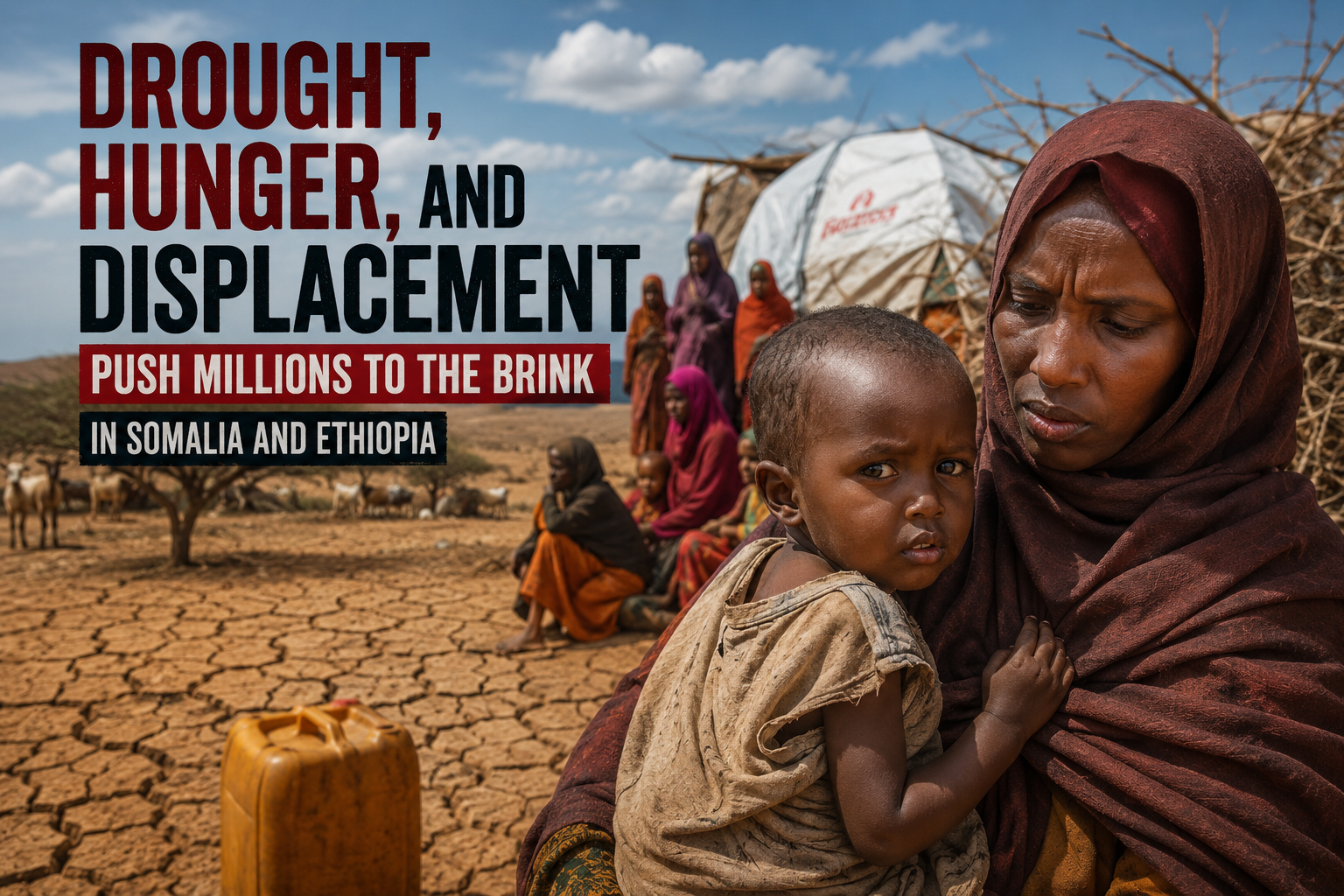
Families across Somalia and Ethiopia’s Somali Region are facing one of the worst humanitarian crises in recent years as drought, hunger, and displacement continue to devastate communities already struggling with conflict and poverty.
Humanitarian organization Médecins Sans Frontières (MSF) warns that millions of people are now at risk after repeated failed rainy seasons destroyed crops, killed livestock, and dried up critical water sources across the Horn of Africa.
Somalia officially declared a national drought emergency late last year, but conditions continue to worsen. More than 6 million people are now facing severe food insecurity, while nearly 2 million children under the age of five are expected to suffer acute malnutrition in 2026.
In displacement camps across Somalia, families are arriving with almost nothing.
Mothers are walking for miles in search of water. Children are showing signs of severe hunger. Clinics are overcrowded with malnourished patients, while aid agencies struggle to respond because of massive funding shortages.
One displaced Somali mother told MSF her family receives only two jerrycans of water per day — water that must be used for drinking, cooking, bathing, and washing.
In many rural communities, the crisis has wiped out livelihoods built around livestock. Camels, goats, and cattle — long considered the backbone of Somali survival and economic life — are dying in large numbers due to lack of rain and pasture.
The disaster is also affecting Ethiopia’s Somali Region, particularly areas near the Somali border where water shortages are forcing families to migrate in search of assistance. Some communities are reportedly drinking unsafe river water shared with animals, raising fears of disease outbreaks.
At the same time, humanitarian funding is collapsing.
Aid organizations say food programs and health services are being cut even as needs rise sharply. More than 70 health facilities in Puntland have reportedly closed due to funding shortages, while hundreds of thousands of people have lost access to clean water.
The World Food Programme has already reduced emergency food assistance for millions of people because of limited resources.
For many Somalis, the crisis is becoming a painful reminder of previous famines that devastated the country and claimed hundreds of thousands of lives.
Climate experts warn that repeated drought cycles linked to climate change are making the Horn of Africa increasingly vulnerable to hunger, displacement, and instability. Communities that once survived seasonal droughts are now facing longer and more destructive dry periods with little time to recover.
As the humanitarian situation deteriorates, aid agencies are calling for urgent international support to prevent the crisis from spiraling into a full-scale famine.
Without immediate assistance, millions of vulnerable families across Somalia and Ethiopia could face even deeper suffering in the months ahead.
Source: MSF Report