

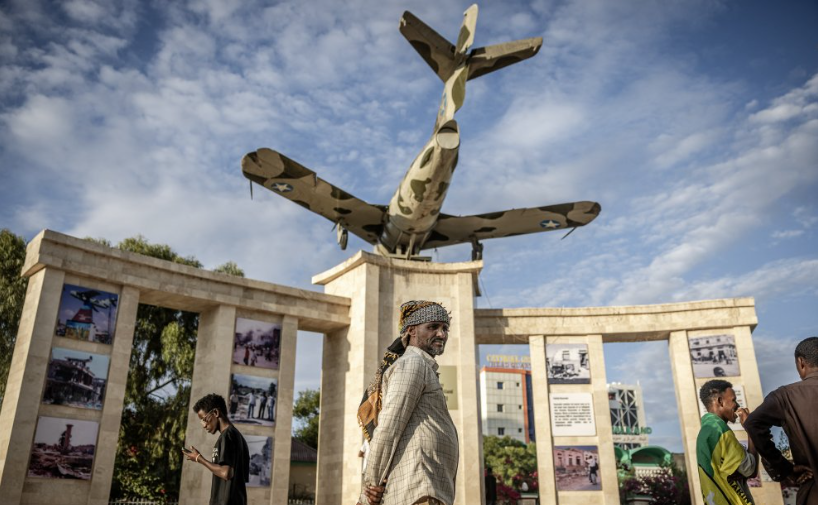
HARGEISA, Somaliland — More than three decades after declaring independence from Somalia, Somaliland continues to present its case for international recognition, arguing that its distinct political history, democratic governance, and the legacy of atrocities committed during Somalia’s civil war justify its claim to statehood.
Although it has operated as a self-governing territory since May 18, 1991, Somaliland remains internationally recognized as part of Somalia. The self-declared republic has built its own government, military, police force, judiciary, currency and electoral system, yet no United Nations member state formally recognizes its independence.
A Brief Union and Separation
The territory that is now Somaliland was formerly the British Somaliland Protectorate, while southern Somalia was administered as Italian Somaliland. British Somaliland gained independence on June 26, 1960, before voluntarily uniting with the former Italian territory five days later to form the Somali Republic on July 1, 1960.
Many Somalilanders argue that the union failed to create an equitable political partnership. Over time, grievances mounted over political marginalization, unequal distribution of resources and increasing authoritarian rule under President Mohamed Siad Barre, who seized power in a 1969 military coup.
The Civil War and Mass Atrocities
Armed resistance intensified during the 1980s, led primarily by the Somali National Movement (SNM), which drew much of its support from northern Somalia. The Barre government responded with a brutal military campaign against areas suspected of backing the insurgency.
The conflict reached its peak in 1988, when government forces launched heavy aerial bombardments and artillery attacks on the cities of Hargeisa and Burao, destroying large sections of both urban centers. Human rights organizations estimate that tens of thousands of civilians were killed, while hundreds of thousands fled into neighboring Ethiopia.
Several human rights groups and scholars have described the campaign against the Isaaq clan as constituting genocide, citing systematic killings, mass detentions, torture and widespread destruction targeting civilians. Others characterize the events as war crimes and crimes against humanity, noting that no international court has issued a legal determination classifying the atrocities as genocide. The issue remains the subject of legal and academic debate.
Declaration of Independence
Following the collapse of Siad Barre’s government in 1991, clan elders and political leaders meeting in Burao declared the restoration of Somaliland’s independence, arguing that the voluntary union of 1960 had effectively dissolved with the fall of the Somali Republic.
Unlike southern Somalia, which experienced prolonged conflict among rival factions, Somaliland embarked on a locally driven peace and reconciliation process. Traditional elders, political leaders and community representatives negotiated ceasefires and developed a constitutional framework that laid the foundation for relative stability.
Democratic Development
Over the past three decades, Somaliland has established many institutions typically associated with sovereign states. It has held multiple presidential, parliamentary and local elections, maintained its own security forces, and developed functioning public institutions despite receiving little international recognition.
Supporters argue that Somaliland’s record of relative peace, democratic transfers of power and institution-building distinguishes it from much of the Horn of Africa.
However, challenges remain, including periodic political disputes, economic constraints, youth unemployment and recurring tensions in eastern regions such as Sool, where competing territorial claims have led to armed confrontations.
The Recognition Debate
Somaliland maintains that it meets the traditional criteria for statehood under international law, including a defined territory, permanent population, effective government and the capacity to engage in international relations.
The Federal Government of Somalia rejects Somaliland’s claim to independence, insisting that the country’s territorial integrity must be preserved. The African Union and the United Nations continue to support Somalia’s sovereignty while encouraging dialogue between Mogadishu and Hargeisa over their future relationship.
For many Somalilanders, international recognition is viewed as the final step in a decades-long effort to secure the sovereignty they believe was restored in 1991. For Somalia and much of the international community, however, the issue remains one of the Horn of Africa’s most complex and sensitive political questions.
As diplomatic discussions continue, Somaliland’s quest for recognition remains intertwined with its history of colonial separation, civil war, mass atrocities and three decades of self-governance—making it one of the world’s longest-running unresolved statehood disputes.