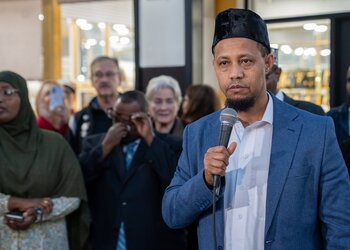


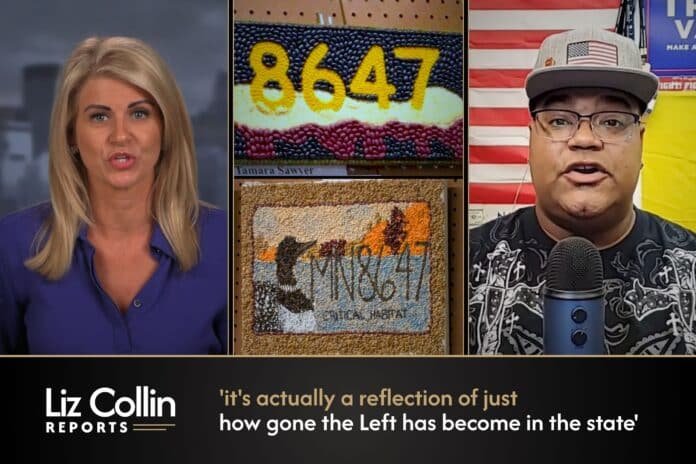
MINNEAPOLIS — Minnesota’s annual State Fair has become an unexpected battleground in the state’s increasingly bitter political and cultural divisions, after Republican National Committeeman AK Kamara accused the political left of pushing what he described as “deranged behavior” into a public event attended by families from across the state.
Kamara, a Minnesota Republican National Committeeman and conservative podcaster, made the comments during an appearance on Liz Collin’s podcast as he discussed several controversies surrounding this year’s fair, including political messages in crop and seed art and an all-ages drag performance.
“I think it’s actually a reflection of just how gone the left has become in the state,” Kamara said, arguing that some displays at the fair represented ideas he believes have become increasingly mainstream within Minnesota’s Democratic-Farmer-Labor Party.
His comments have added another layer to an already heated debate over whether political activism and culture-war issues have become too prominent at one of Minnesota’s best-known public gatherings.
The crop-art controversy
One of the most visible disputes involved an entry featuring the numbers “8647”, created with beans as part of the State Fair’s celebrated crop-art competition.
The display generated controversy because “8647” has been interpreted by critics as a reference to removing President Donald Trump from office, using “86” as slang for getting rid of something and “47” referring to Trump as the 47th president.
The artwork was displayed publicly at the fair before reportedly being removed at the artist’s request. The controversy subsequently intensified online, with competing accusations about political intimidation, threats and the treatment of the artist.
Kamara also pointed to other political imagery at the fair, including artwork referencing immigration enforcement and the deaths of figures such as George Floyd, Renee Good and Alex Pretti.
He characterized what he saw as a broader political message centered on resistance, violence and opposition to government authority.
Those interpretations, however, are political arguments rather than established findings about the intentions of every artist or display at the fair.
Drag performance sparks another fight
The second major flashpoint involved POWER: Drag Revue, which performed at the Minnesota State Fair on Aug. 27 and 28.
The State Fair promoted the event as an all-ages performance celebrating the artistry and diversity of Minnesota’s drag community. A Republican state lawmaker, Rep. Pam Altendorf, criticized the performance after recording footage showing children approaching a performer and handing over dollar bills.
Altendorf said adults should be free to attend drag performances but objected to presenting such a performance as family entertainment.
Kamara echoed the criticism, describing what he saw as part of a larger ideological shift in Minnesota.
He argued that ordinary working-class Minnesotans were not demanding more drag performances for children and connected the issue to what he characterized as the influence of “critical gender theory” within the state’s Democratic political establishment.
A fair caught in a wider political battle
The dispute illustrates how the Minnesota State Fair — traditionally associated with food, agriculture, entertainment and community — has increasingly become a stage for political disagreements.
For conservatives, the controversies demonstrate what they see as the growing influence of progressive politics in institutions and public spaces.
For others, political expression and cultural performances at the fair are part of the broader diversity of Minnesota society, and criticism of those displays represents an attempt to restrict what can be publicly presented.
The disagreement is occurring against an especially tense political backdrop in Minnesota.
The state has experienced fierce disputes over immigration enforcement, political violence, gender policy and the direction of state government. The Republican Party has also raised concerns about security at the fair and announced that it had hired off-duty police officers for its booth amid reported safety concerns.
“Reject the premise”
Kamara’s response to conservatives who dislike what they see at the fair was not to simply walk away.
Instead, he urged them to challenge it publicly.
“Reject the premise,” he said. “Tell the State Fair that you don’t like the things that you’re seeing.”
That approach reflects a broader strategy emerging within conservative politics: rather than accepting cultural changes as inevitable, activists are increasingly using public institutions, elections and consumer pressure to challenge them.
The State Fair, meanwhile, remains a public gathering where competing visions of Minnesota are increasingly visible side by side.
For one side, the displays represent inclusion, artistic freedom and changing cultural norms.
For the other, they represent a political and cultural transformation that has gone too far.
And that makes the Minnesota State Fair more than a summer tradition this year.
It has become another front in America’s widening culture war — where even crop art, children’s entertainment and a trip to the fairgrounds can become political battlegrounds.