



MOGADISHU — At a time when millions of Somalis are struggling to find enough food, one of the world’s most closely watched famine-warning systems stopped reporting on Somalia.
The disappearance of Somalia from key U.S.-backed food-security reports has raised fresh concerns among humanitarian workers, who say the loss of timely information could make it harder to identify hunger emergencies before they become deadly.
The system at the center of the controversy is the Famine Early Warning Systems Network, or FEWS NET, a U.S.-supported program created four decades ago to help governments and aid organizations anticipate food crises. Its analysts combine satellite imagery, crop and market information, climate data and field reports to forecast where severe hunger is likely to emerge.
The Trump administration’s foreign-aid overhaul disrupted the system in 2025, when FEWS NET was suspended for about six months during a broad freeze on U.S. foreign assistance. It later resumed operations.
Now, the controversy has returned.
Somalia disappeared from the map
In recent months, FEWS NET stopped publishing regular updates for Somalia, Afghanistan and Yemen.
For Somalia, the omission came at a particularly troubling moment.
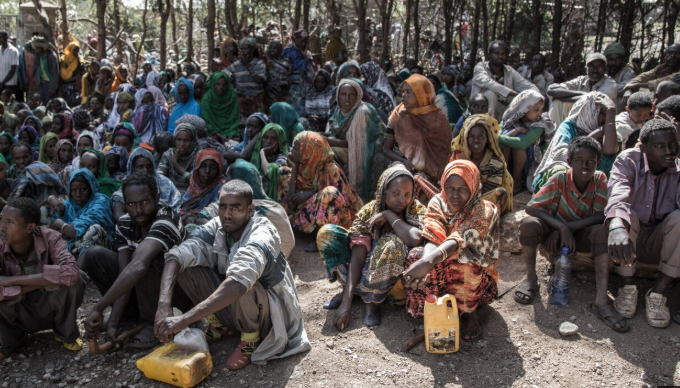
An estimated 6.5 million Somalis — roughly one-third of the population — are facing acute food insecurity, according to figures cited by humanitarian officials. Aid groups working around Baidoa have reported severe malnutrition among children and increasing numbers of families surviving on extremely limited food.
For humanitarian workers, the absence of FEWS NET’s familiar maps and forecasts was difficult to ignore.
Jeremy Konyndyk, a former senior USAID official and now president of Refugees International, told NPR that Somalia has historically been among the countries most extensively covered by the system.
He described the current situation as particularly dangerous because the country is experiencing severe food insecurity precisely when early-warning information is most needed.
Then came a reversal.
The U.S. State Department told NPR that FEWS NET would resume reporting on Somalia, Yemen and Afghanistan in September.
But the episode has left questions about the future independence and reliability of the system.
Why FEWS NET matters
Famine does not usually arrive without warning.
Drought, crop failures, livestock losses, food-price increases, conflict and displacement can build into a crisis over months.
FEWS NET’s purpose is to identify those warning signs early enough for governments and aid agencies to act.
Its forecasts can look several months into the future, allowing humanitarian organizations to move food, medicines and other supplies toward vulnerable communities before a crisis reaches its worst point.
That advance warning can be the difference between prevention and emergency response.
Aid workers say the system has also helped identify specific locations where assistance is most urgently needed, rather than distributing limited resources blindly.
Somalia’s worsening crisis
The timing of the reporting gap has alarmed humanitarian organizations because Somalia is already dealing with a combination of drought, displacement, conflict and reduced international assistance.
The country has endured repeated climate shocks over the past several years. Failed or below-average rainy seasons have pushed pastoralists and farmers from their livelihoods and driven families toward displacement camps and urban centers.
At the same time, funding cuts have reduced the capacity of humanitarian agencies to respond.
According to figures cited by NPR, U.S. assistance to Somalia reached about $770 million during the Biden administration, while funding for food assistance has subsequently been sharply reduced. The World Food Program has reportedly cut the number of Somalis it reaches each month from about 2 million to roughly 350,000, with those beneficiaries receiving only partial rations.
UNICEF has also reported the closure of hundreds of facilities involved in treating malnourished children because of funding shortages, according to NPR.
For families already living on the edge, those cuts can have immediate consequences.
The warning comes from the field
Aid workers describe conditions that are increasingly difficult to reconcile with the disappearance of Somalia from some U.S. hunger reports.
Doctors Without Borders reported severe malnutrition among children in displacement camps near Baidoa. Its teams also treated thousands of pregnant and breastfeeding women for malnutrition during the summer.
One humanitarian worker described seeing an 11-month-old girl arrive at a displacement camp so weak that she appeared to be between life and death. After weeks of treatment, the child recovered.
But aid workers say such cases are becoming more common as drought forces more people from rural areas into camps where food and health services are already stretched.
Is hunger data becoming political?
That is the question now hanging over FEWS NET.
The State Department says country coverage has historically changed according to factors including humanitarian need, policy priorities, access and cost efficiency.
Critics, however, worry that political considerations could influence where and how hunger is measured.
Michelle Jurkovich, a food-aid policy expert at the University of Massachusetts Boston, warned that the credibility of early-warning systems could suffer if governments are able to influence where data is collected or reported.
That concern extends beyond Somalia.
If an early-warning system stops reporting on a country experiencing a worsening food crisis, humanitarian organizations may lose one of the tools they use to anticipate where famine could emerge next.
Other systems remain
FEWS NET is not the only source of food-security information.
The United Nations uses the Integrated Food Security Phase Classification (IPC), while the World Food Program maintains its own hunger-monitoring systems.
But humanitarian experts say FEWS NET has a particular advantage because of its combination of satellite information, field analysis and forward-looking forecasts.
The system was created in 1985 after devastating famines in Africa, with the goal of ensuring that governments would receive warnings early enough to prevent future catastrophes.
Forty years later, that original mission is once again being tested in Somalia.
A warning system caught in a larger debate
The dispute over FEWS NET reflects a much broader argument about the future of U.S. foreign assistance.
The Trump administration’s restructuring of U.S. aid has dramatically altered the way Washington funds humanitarian programs overseas.
Supporters of the changes argue that U.S. foreign assistance should be more closely aligned with American foreign-policy priorities.
Humanitarian organizations counter that famine does not wait for geopolitical priorities.
In Somalia, that distinction can be measured in missed meals, closed clinics and children arriving at treatment centers dangerously malnourished.
FEWS NET’s return to Somalia in September may restore an important source of information.
But the episode has exposed a vulnerability that humanitarian agencies cannot easily ignore: the world’s ability to see a famine coming can depend on political decisions made thousands of miles away.
And in a country where millions are already facing hunger, losing the warning may mean losing precious time to prevent the next disaster.


