





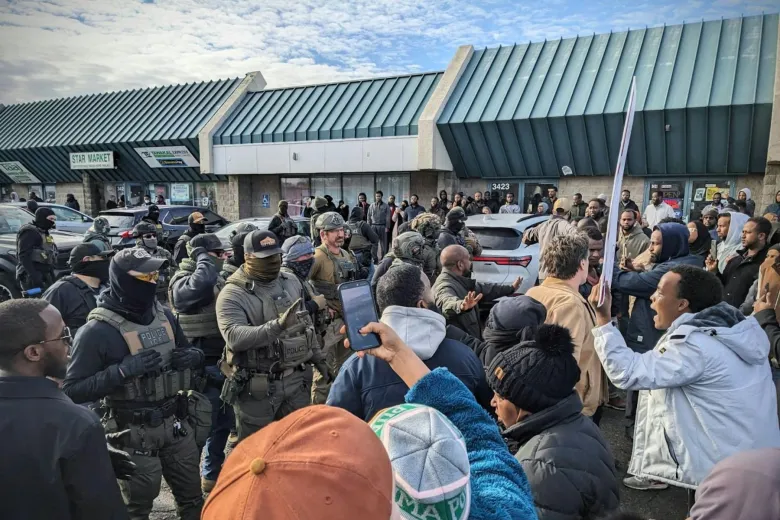
MINNEAPOLIS — Months after a major federal immigration enforcement operation brought fear and uncertainty to Minnesota’s immigrant communities, the visible presence of Immigration and Customs Enforcement agents has diminished. But for many Somali Americans, the anxiety has not disappeared.
In a recent commentary for the Minnesota Star Tribune, Augsburg University student Eva Skipwith describes how the ICE surge changed everyday life for her and others in Minnesota’s Somali community. She writes that she still carries a copy of her passport and maintains an emergency plan with her boyfriend in case she is targeted by immigration authorities.
Skipwith, who is of mixed Somali and American heritage, says the federal crackdown made ordinary activities — attending classes, going to the library or taking public transportation — feel different.
The fear intensified during Operation Metro Surge, when federal immigration enforcement activity increased across Minnesota. Skipwith says the operation particularly affected Somali residents, many of whom were already concerned about the possibility of immigration enforcement and deportation.
For Somali Americans who are U.S. citizens, the experience has also raised broader questions about belonging and identity. Skipwith writes that although many members of the community were born or raised in the United States, the appearance of intensified federal enforcement made some feel that their place in the country could suddenly be questioned.
Fear reaches college campuses
The anxiety extended to Minnesota colleges and universities.
Skipwith recounts an incident at Augsburg University in which a student was detained by ICE after being followed into a campus parking lot. She says students who gathered to show support were confronted with weapons.
The episode affected students’ willingness to attend classes and participate in normal campus activities. Study groups became smaller, and conversations that would normally center on schoolwork increasingly focused on whether students would feel safe returning to campus.
The experience eventually changed how Skipwith moved around Minneapolis.
During a trip to a library with a friend, students heard whistles being used as a warning about the presence of ICE agents. Rather than simply leaving the building, Skipwith and her friend began thinking about what they would do if she were detained.
Her friend offered to accompany her to the bus stop.
Skipwith responded that she had a copy of her passport in her bag.
The exchange became part of an emergency plan that she says remains in place today.
The raids may have slowed, but the anxiety remains
The immediate intensity of ICE activity has since declined, according to Skipwith. But she argues that the psychological effects of the operation have lasted well beyond the visible presence of federal agents.
For some immigrants, a social-media post, a news report or a sign in a neighborhood can bring back memories of the enforcement campaign.
That lingering uncertainty has become one of the most significant consequences of the crackdown.
The experience also highlights the divide between citizens and noncitizens within Minnesota’s Somali community. While most Somali Americans are U.S. citizens, others have immigration statuses that could potentially leave them vulnerable to removal. For those individuals, the possibility of being sent to Somalia carries particular fears because of the country’s continuing security and political challenges.
A community trying to move forward
Despite the fear, Skipwith says Somali and other immigrant communities continued working, studying and supporting one another.
The story reflects a broader reality in Minnesota: immigration enforcement can have effects that extend beyond the people directly detained. Families, students, businesses, universities and neighborhoods can all experience the consequences of heightened enforcement.
For many Somali Minnesotans, the question now is not simply whether ICE agents remain visible on the streets. It is whether the sense of security that existed before the surge can return.
For Skipwith, the answer remains uncertain.
She still carries her passport.
And although the fear has become less immediate, she writes that the possibility of having her life uprooted again never feels completely gone.