




MOGADISHU — Somalia is once again confronting a devastating hunger crisis, with children bearing the heaviest burden as drought, conflict, displacement and shrinking humanitarian assistance combine to push vulnerable families deeper into desperation.
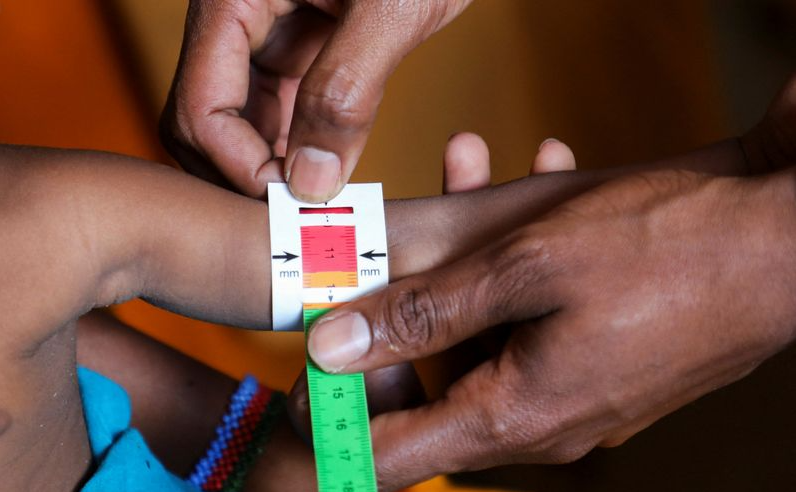
A new survey by Médecins Sans Frontières (Doctors Without Borders) found that roughly one-third of displaced families in one Somali region are surviving on just one meal a day, according to reporting by New Hampshire Public Radio and NPR. Aid workers say increasingly severe cases of malnutrition are arriving at treatment centers, with some children coming dangerously close to death.
The crisis is unfolding at a particularly dangerous moment.
UNICEF estimates that about 1.9 million children in Somalia will experience acute malnutrition this year, including nearly 500,000 children expected to suffer from severe acute malnutrition, the most dangerous form of the condition.
And the humanitarian system that is supposed to respond is itself running short of resources.
A child crisis hidden behind the numbers
For families displaced by drought and conflict, hunger is no longer an occasional hardship.
It is becoming a daily reality.
Aid workers interviewed by NPR described children arriving at nutrition centers after their families had been forced from farms and rural communities by years of drought. In displacement camps, families often have little or no reliable source of food.
Mukhtar Sirat Mahdi, who coordinates malnutrition treatment centers for the International Rescue Committee, described increasingly desperate cases involving children who have become severely weakened after their families lost their livelihoods.
One infant he recalled spent six weeks recovering after being brought to a treatment center.
Aid workers warn that such cases are becoming more frequent.
The consequences extend beyond immediate survival. Severe malnutrition can affect children’s development, health and ability to learn — potentially leaving lasting damage long after the hunger crisis ends.
Drought is driving families from their homes
Somalia’s current crisis is being driven by several forces at once.
Years of unreliable rainfall have damaged crops, depleted water sources and weakened livestock-dependent communities. Conflict has made it even harder for families to remain in rural areas or for humanitarian organizations to reach them.
Many have been forced to leave their homes and seek assistance in displacement settlements around major cities.
The result is a cycle that is difficult to escape:
Drought destroys livelihoods. Conflict drives people from their homes. Displacement makes families dependent on assistance. And cuts to that assistance leave them with nowhere else to turn.
The World Food Program estimates that around six million people in Somalia are facing acute food insecurity.
Nearly 200 nutrition facilities have already closed
The humanitarian response is facing an additional crisis: funding.
UNICEF says 205 health and nutrition facilities have already closed because of unprecedented reductions in humanitarian funding. As many as 618 facilities could eventually close nationwide if the funding situation does not improve.
That has immediate consequences.
When a health center closes, families must travel farther to find treatment. For mothers carrying malnourished babies, even a few additional kilometers can be the difference between receiving treatment early and arriving when a child is already critically ill.
UNICEF has warned that longer journeys mean later treatment, more severe illness and a greater risk of preventable deaths.
U.S. aid cuts add to the pressure
Somalia’s worsening crisis comes after major reductions in international humanitarian assistance.
Médecins Sans Frontières said funding for acute-malnutrition programs in parts of Somalia has fallen by more than 80% this year, with the United States halting funding and other Western countries also reducing support.
The consequences are visible on the ground.
Organizations that previously operated multiple treatment and nutrition programs are being forced to scale back or close facilities just as the number of children needing assistance is increasing.
That creates a dangerous mismatch:
The need is growing while the response is shrinking.
The WFP has a fraction of the resources it had during the last crisis
The World Food Program says its current resources are dramatically smaller than those available during Somalia’s 2022 hunger emergency.
WFP acting Executive Director Carl Skau said the agency now has only about one-tenth of the resources it had in 2022, when international intervention helped prevent famine.
The agency is consequently prioritizing children who are already the most severely affected.
That means many families experiencing hunger may receive little or no assistance until their condition becomes critical.
Humanitarian officials say this is precisely the wrong moment to reduce assistance.
Families are running out of options
At nutrition centers around Mogadishu, mothers arrive carrying children who have lost significant weight.
Some have walked for hours.
Others have traveled from rural areas after losing their homes and livelihoods.
One mother described to the Associated Press how she fled Lower Shabelle after her husband died from malnutrition. She walked for four nights with her children before reaching a displacement camp outside Mogadishu. At one point, she said, she herself had gone two days without eating.
Her story reflects a broader reality: mothers are often forced to make impossible choices about which children they can physically carry to treatment centers.
Meanwhile, the children left behind continue to wait for food.
Conflict makes the crisis even harder to solve
Somalia’s hunger emergency cannot be separated from its security crisis.
The continuing insurgency by al-Shabaab restricts movement in some areas and makes humanitarian operations more expensive and dangerous.
Aid organizations sometimes have to use aircraft to transport personnel and supplies into areas that cannot safely be reached by road. Some communities remain effectively inaccessible.
That means money is needed not only to buy food and medicine, but also to transport assistance and maintain access to isolated communities.
Every additional security barrier increases the cost of saving lives.
The warning signs are unmistakable
Somalia has experienced devastating hunger crises before.
The international community helped prevent a famine during the 2022 drought after rapidly scaling up assistance.
Humanitarian officials now fear that the lessons of that crisis are being forgotten.
The current situation is not simply about food shortages. It is a convergence of climate stress, conflict, displacement, poverty, rising prices and shrinking international assistance.
UNICEF says the number of children admitted to health facilities with severe acute malnutrition and related complications has risen by 32%.
That increase is one of the clearest indicators that the crisis is moving in the wrong direction.
Somalia cannot afford another humanitarian funding collapse
The international community still has an opportunity to prevent the situation from becoming even worse.
Somalia has experienced famine before. It has also demonstrated that early intervention can save lives and prevent a humanitarian disaster from reaching its worst stage.
But early intervention requires resources.
Closing hundreds of health and nutrition centers while millions of children are at risk moves Somalia in precisely the opposite direction.
The country’s children did not cause the drought.
They did not start the conflict.
And they did not decide to cut humanitarian assistance.
Yet they are the ones paying the highest price.
The latest figures should therefore be understood not simply as another humanitarian warning, but as a race against time.
Nearly 1.9 million children are projected to face acute malnutrition this year, while hundreds of treatment facilities are already disappearing and humanitarian funding has plunged.
Somalia has seen what happens when the world waits too long.
The question now is whether the international community will act before hunger becomes another catastrophe that could have been prevented.
For millions of Somali families, the emergency is not approaching. It is already here.


