
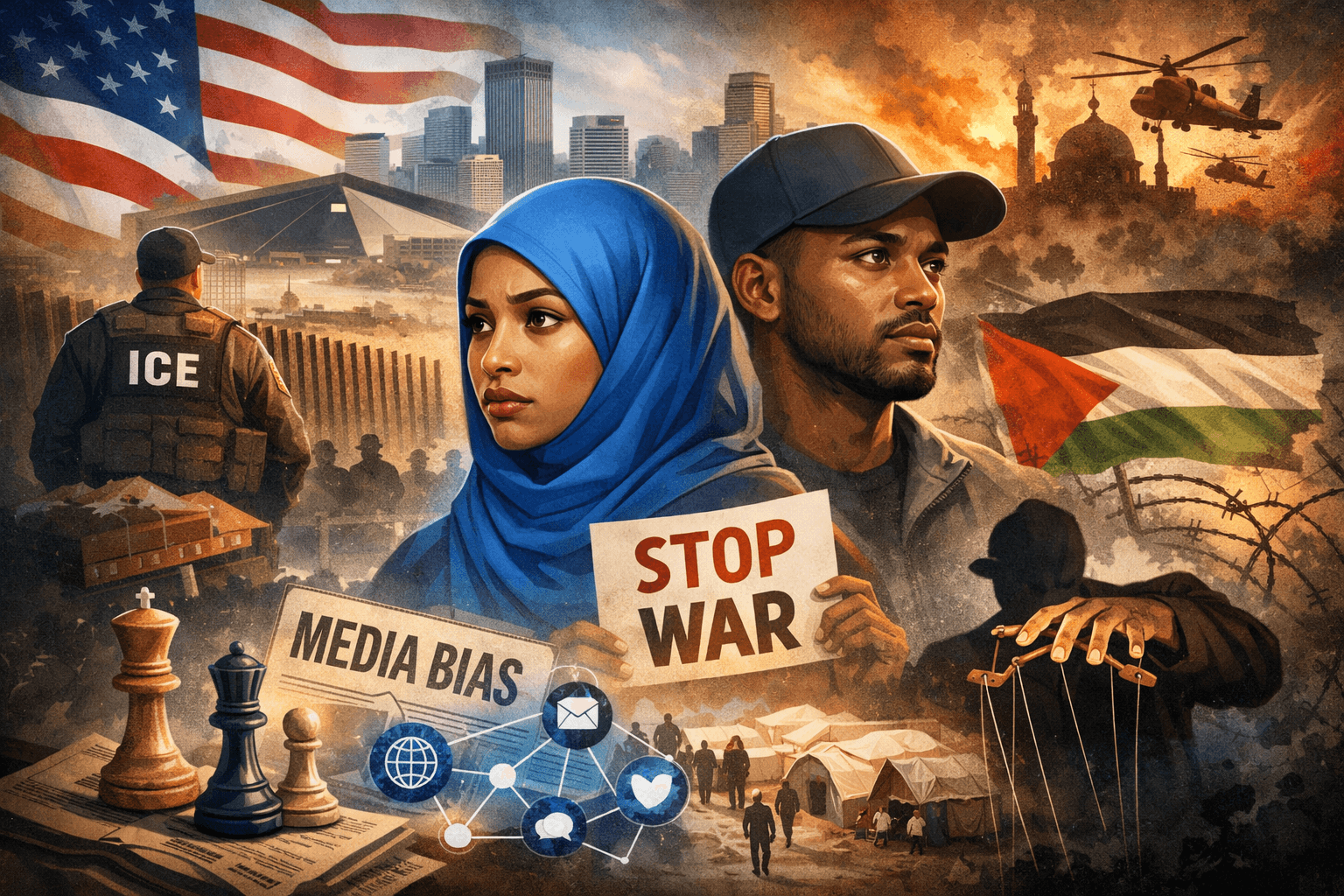
This article is an opinion-based reflection. It does not present conclusions or accusations. It gathers scenarios being discussed in public spaces and treats them as possible explanations, not established facts. Somali Media encourages critical thinking, verification, and responsible dialogue.
Many in the Somali community are asking a difficult question:
Why does it feel like pressure, tension, and targeting are increasing around Somali Americans, particularly in Minnesota at the same time global political storms are intensifying?
There is no single proven answer. But several possibilities are being discussed.
Domestic U.S. Politics and Immigration Pressure
One possibility is that these pressures are rooted in U.S. domestic politics. Immigration remains one of the most sensitive political issues in America. Somali Americans occupy a unique intersection of:
- Immigration policy
- Muslim identity
- Refugee history
- Political activism
When national politics become aggressive, immigrant communities often feel the impact first. Increased enforcement, investigations, or political messaging may reflect election strategies rather than any hidden international agenda.
Global Conflicts Increasing Suspicion of Muslim Communities
Ongoing wars in Palestine and rising instability in the Middle East often lead governments worldwide to scrutinize Muslim communities more closely. Somali Americans may feel this pressure not because of wrongdoing, but because global crises make authorities more cautious, defensive, and sometimes less fair. This is a historical pattern, not a new phenomenon.
The Palestinian Relocation Debate
Many Somalis strongly oppose the idea that Palestinians should be relocated to Somali lands. Their stance reflects principles of justice:
- Displacement is not a solution
- Palestinians deserve their homeland
- Somalia should not become a dumping ground for international problems
While there is no evidence of retaliation, some fear that rejecting such proposals could put Somalis in tension with powerful global actors, reflecting longstanding distrust in international power dynamics.
The Epstein Case and Power Exposure
The Epstein case revealed that powerful individuals can sometimes be shielded by complex systems of influence. Some speculate that:
- Further revelations could implicate high-ranking individuals
- These individuals may try to distract or redirect public focus
- Global crises can intensify when powerful interests feel threatened
Again, these are unproven, but they illustrate why sudden political chaos often follows major exposures.
Fear of Blackmail or Leverage
Some suggest that:
- Sensitive information might be used to influence political decisions
- Governments sometimes act to protect elites
- Smaller nations or vulnerable communities may become bargaining chips
There is no evidence this is happening with Somalia or Somali Americans, but historical patterns show that power is rarely exercised without strategy.
Media Narratives and Targeting
Media framing can shape public perception, even without wrongdoing. When Somali communities are discussed in contexts such as:
- Immigration
- Protests
- Security
- Politics
The repeated framing can create suspicion, influencing how communities are perceived.
Social Media Amplification
Social media often connects unrelated events—Epstein, Palestine, Somalia, Zionism, U.S. politics, Minnesota protests. Online, these connections feel real emotionally, but emotional resonance does not equal political coordination.
The Psychology of Powerlessness
When communities feel unheard or threatened, they naturally search for hidden explanations. This is a universal human response. Asking questions is not a sign of paranoia—it is a way to seek understanding and regain a sense of control in uncertainty.
Historical Memory of Injustice
Somali communities carry memories of:
- Colonial exploitation
- Political betrayal
- Refugee displacement
- Broken international promises
So when tension rises, people may anticipate injustice even before evidence appears.
The Most Responsible Conclusion
All the scenarios above are possibilities, not confirmed facts. What is certain is that:
- Somali Americans deserve dignity
- They are not responsible for global wars
- They cannot be punished for refusing injustice
- They must not become political scapegoats
Somali Media’s role is not to confirm fear, but to protect truth.
Our position:
- We question power
- We reject forced displacement
- We demand evidence before assigning blame
- We defend our community responsibly
Until proven otherwise, these reflections are neither conspiracies nor confirmed truths—they are attempts by a community to understand why pressure feels heavier and why the world sometimes seems less fair.
That is not weakness. That is awareness.